

Sundew
Botanical name
Drosera rotundifolia L.
Family
Droseraceae
Common name
Common sundew, Round-leaved sundew
Information about the plant
With 85 species, the genus Drosera is mainly distributed in the Southern Hemisphere, especially in Australia and New Zealand. In Europe, only three species occur: D. rotundifolia (common sundew), D. intermedia (oblong-leaved sundew), and D. anglica (English Sundew). All three have a circumpolar distribution that extends from temperate and boreal zones into the subarctic zone. Sundew grows in moist to wet, nutrient-poor peat soils. It thrives among sphagnum mosses in raised bogs, transitional bogs, and acidic fens, as well as in damp matgrass meadows and heaths. It can also be found along ditch margins and on wet rocks.
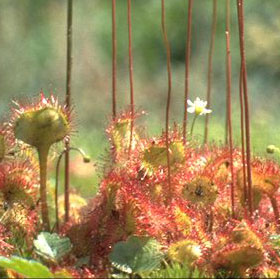
The circular to transversely oval leaves of the sundew form a basal rosette that lies close to the ground. In summer, 7 to 15cm long, hairy, leafless flowering stems emerge from the rosette, each bearing 4 to 12 flowers that blossom only briefly. On the upper surface of the leaves and on small glands, especially along the margins, there are reddish, glandular hairs, so-called tentacles. These act as “sticky traps” for small insects, as the gland heads secrete droplets of a sticky substance that glisten in the sun - hence the name “sundew” and Drosera (from the Greek “droseros” = dewy, covered in dew). Insects remain adhered to these sticky glands, trying to escape and thereby touching further sticky glands. In addition, sensory stimuli cause tentacles to writhe and press the trapped insects against the leaf surface, where they are digested by proteolytic enzymes in the secretion. Only the insects’ exoskeletons remain, which are often seen on the sundew leaves. Through this process, the sundew supplements the nutrient-poor conditions of moors, especially regarding nitrogen and phosphorus.
Medicinally used parts of plants (herbal drug)
The dried herb (Droserae herba), consisting of the above- and below-ground parts of the plant, is used. The drug originally came from European species, primarily round-leaved sundew. Since the species in Europe are threatened with extinction, they are now strictly protected and may not be collected. Therefore, as a substitute, the drug is obtained from African wild populations, mainly from D. ramentacea, D. madagascariensis, and D. peltata. Supply may become critical in the future.
Constituents of the herbal drug
Sundew herb contains 1.4-naphthoquinone derivatives (e.g. 7-methyl juglone, plumbagin) and flavonoids.
Quality of the drug
The quality of sundew herbs is not specified in the pharmacopoeias (Ph. Eur, DAB, DAC). A monograph is included in the supplement to DAB 6 (Suppl. B. 6).
Medical applications
Recognised medical use
Sundew has not been reviewed by the HMPC or ESCOP.
Traditional use
Sundew herb is not listed as a traditional herbal medicinal product (Article 16a of Directive 2001/83/EC).
Herbal drug preparations in finished dosage forms
- Cut herb for tea preparation
- Drosera homeopathic mother tincture in drops and juice
Dosage
Finished medicinal product: See patient information leaflet.
Tea: Drink 1 cup of sundew tea 3 to 4 times daily.
Preparation of a tea
Pour boiling water over 2 to 5 g of finely chopped sundew herb and strain after 10 minutes.
Notes
There are no studies available on the safety of sundew use during pregnancy and lactation. Use in children under 6 years of age is not recommended due to a lack of evidence.
Side effects
None known.
Interactions
None known.