
Basil
Botanical name
Ocimum basilicum L.
Family
Lamiaceae
Common name
Sweet Basil, Common Basil, Garden Basil, Great Basil
Information about the plant
Basil has been cultivated for many centuries, so its precise origin can no longer be determined. It likely originates from north-western India and is now widespread throughout southern Asia, north-eastern Africa, and tropical America. In tropical and temperate regions, basil is cultivated in gardens and fields; it has been grown in Germany since the 12th century. Today, basil is widely used as a spice.
The genus name Ocimum is derived from the Greek word ‘ozein’ (= to smell, to scent), and the Greek plant name is ‘Okimon’. The species epithet basilicum, from which the German name “Basilikum” is also derived, comes from the Medieval Latin ‘basilicum’ (= the royal), which was then changed to ‘basilicus’ (= royal, princely) in Latin. Basil is therefore regarded as the “royal herb,” certainly because of its scent.
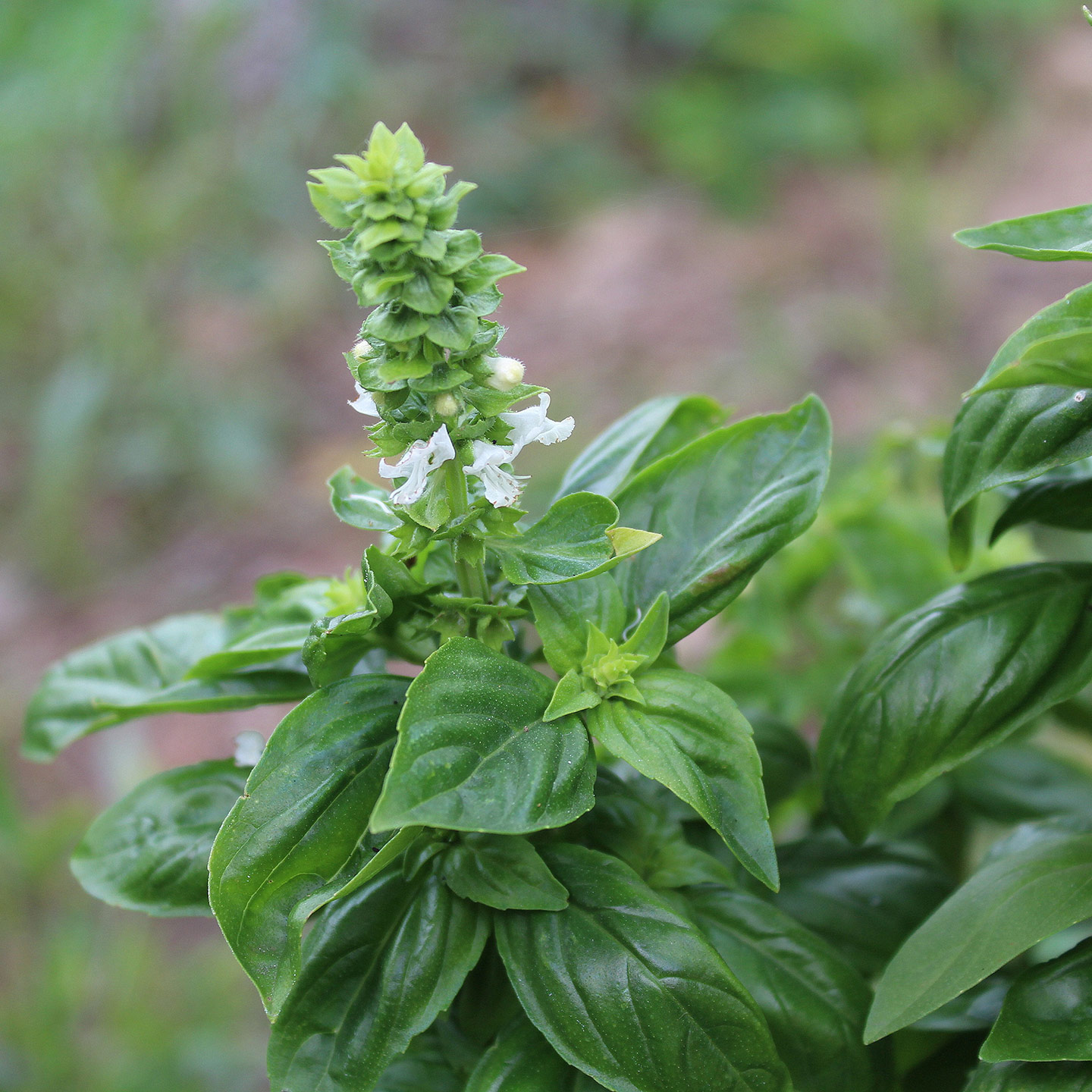
Basil is an annual, pleasantly aromatic herb that grows to a height of 20 to 45 cm and is highly branched. The leaves are 3 to 5 cm long and 2 to 3 cm wide and grow in opposite pairs on a square stem with short petioles. When examined with a magnifying glass, Lamiaceae glandular scales can be seen on the leaf surface; these contain the fragrant essential oil, which is released when the glands are crushed. The yellowish-white to reddish, bilabiate flowers are axillary and arranged in mostly six-flowered cymes on the upper parts of the stems. They have a broad, four-lobed upper lip and a slightly longer, spoon-shaped, curved lower lip on which the stamens lie. The fruit is a dark brown schizocarp.
Medicinally used parts of plants (herbal drug)
The dried herb (basil herb, basil plant – Basilici herba) is used for its spicy aroma, which comes from the essential oil.
The commercially available drug comes from southern France, Italy, Bulgaria, Hungary, Morocco, and Egypt.
Constituents of the herbal drug
Basil herb contains essential oil (basil oil), with the monoterpene linalool as its main component, as well as other monoterpenes and sesquiterpenes. Phenylpropanes include eugenol, methyl cinnamate, and estragole. Basil also contains Lamiaceae tannins, flavonoids, sitosterol, and ursolic acid. Several chemotypes of the essential oil have been described, including an estragole type (see “Notes”).
Quality of the drug
There is no pharmacopoeia quality description available for basil herb.
Medical applications
Recognised medical use
Basil herb has not been evaluated by either the HMPC or ESCOP.
Traditional use
Basil herb has not been classified as a traditional herbal medicinal product (Article 16a of Directive 2001/83/EC) and is not listed as a traditional medicinal product.
Herbal drug preparations in finished dosage forms
- Chopped basil herb for tea preparation
Dosage
Finished medicinal product: See patient information leaflet.
Tea: Drink one cup of basil tea two to three times daily between meals. Daily dose: 2 to 8 g of the herbal drug.
Preparation of a tea
Pour 150 mL of hot water (not boiling!) over 2 to 4 g of finely chopped basil, allow to stand for 10 to 15 minutes, then strain.
Notes
Results from animal studies with estragole as a pure substance indicate a carcinogenic effect. These findings cannot be directly extrapolated to commercially available basil, as estragole is present only at low concentrations in the herb. The oil content in basil herb does not exceed 0.7%, and the concentration of estragole in the essential oil is only 2 to 10%. However, it cannot be ruled out that the estragole type, whose essential oil contains 80 to 90% estragole, may mistakenly appear on the market. To be on the safe side, basil should not be used for medicinal purposes. Basil should not be used during pregnancy or lactation, and its medicinal use is not recommended for children and adolescents under the age of 18.
Side effects
None known – see “Notes”.
Interactions
None known.