

Rupturewort
Botanical name
Herniaria glabra L. - Smooth rupturewort
Herniaria hirsuta L. - Hairy rupturewort
Family
Caryophyllaceae
Common name
Green carpet, Glabrous rupturewort
Information about the plant
Smooth rupturewort is widespread from Europe to Western Siberia, the Mediterranean region, Iran, and North Africa. It prefers dry, loose sandy or gravelly soils and is often found on dirt roads and field edges. Hairy rupturewort is a sub-Mediterranean species that occurs in the Canary Islands, across the Mediterranean region to Pakistan, and in East Africa and South America.
The genus name Herniaria is derived from the Latin “hernia” (= rupture), which refers to an abdominal hernia (the medical term for a “rupture of the intestines,” a sac-like protrusion of the peritoneum). This is also reflected in the German name “Bruchkraut” (hernia herb), as it was formerly used to treat hernias (inguinal hernias, hernias). The species epithet glabra comes from Latin glaber (fem. ‘glabra’), meaning “smooth, hairless, bald”. Hirsuta is also Latin and means “hairy”.
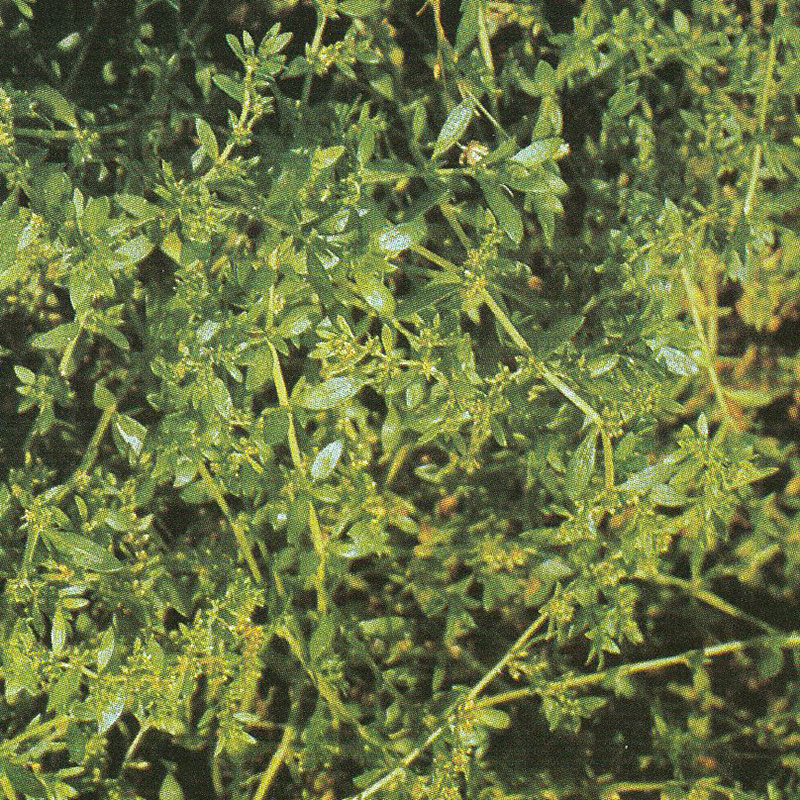
Both species of rupturewort are annual to perennial, prostrate, branched herbs. Their stems are up to 20 cm long and bear small, opposite leaves that taper at the base and have small stipules. Up to ten flowers are arranged in small clusters in the leaf axils. They have small, greenish-white petals and small sepals, which are hairless in smooth rupturewort and bristly hairy in hairy rupturewort, ending in an awn. The stems and leaves of hairy rupturewort are also densely hairy and gray-green. The flowering time is from June to October (smooth rupturewort) and from May to September (hairy rupturewort).
Medicinally used parts of the herbal drug
The aerial parts, consisting of leaves, stems, and flowers, harvested and dried during flowering (rupturewort herb – Herniariae herba), are used.
The commercially available drug comes from wild collections.
Constituents of the herbal drug
Rupturewort contains mono- and bidesmosidic triterpene saponins (Herniaria saponins; aglycone: medicagenic acid), flavonoids, coumarins, and tannins.
Quality of the herbal drug
The quality of rupturewort (Herniariae herba) is specified in the German Drug Codex (DAC).
Medicinal application
Recognised medicinal use
The HMPC has classified rupturewort as a traditional herbal medicinal product (see “Traditional use”).
ESCOP: Rupturewort has not been reviewed.
Traditional use
Rupturewort has been classified by the HMPC as a traditional herbal medicinal product (Article 16a of Directive 2001/83/EC). Based upon long-standing use, rupturewort can be used to increase urine production and flush the urinary tract, and as an adjuvant in minor urinary complaints.
Herbal drug preparations in finished dosage forms
Finished preparations are not available. Dried herbs for tea preparations are commercially available, also in mixtures with other medicinal herbs (diuretic tea).
Dosage
Tea: Drink one cup of freshly prepared rupturewort tea, warm 3 to 5 times a day.
Maximum daily dose: 10 g of the drug.
Preparation of a tea
Pour 150 mL of cold water over 1.5 g of finely chopped rupturewort, bring to a brief boil, and strain after 5 minutes.
Notes
Rupturewort is mainly used in folk medicine. Detailed knowledge about its effects and adverse reactions is not available. In the absence of sufficient data, its use during pregnancy or lactation, or for children and adolescents under 18 years of age, is not recommended.
Side effects
None known.
Interactions
None known.