

Rose - Rose Hip
Botanical name
Rosa canina L. - Dog rose
Rosa pendulina L. - Alpine rose
Rosa gallica L. - Gallic rose
Rosa × centifolia L. - Hundred-petaled rose
Family
Rosaceae
Common name
Dog rose: Witches’ briar, Rose haws, Rose hips, Hipberries, Wild rose fruit
Alpine rose: Mountain rose
Gallic rose: French rose
Hundred-petaled rose: Hundred-leaved rose, Cabbage rose, Provence rose, May rose
Information about the plant
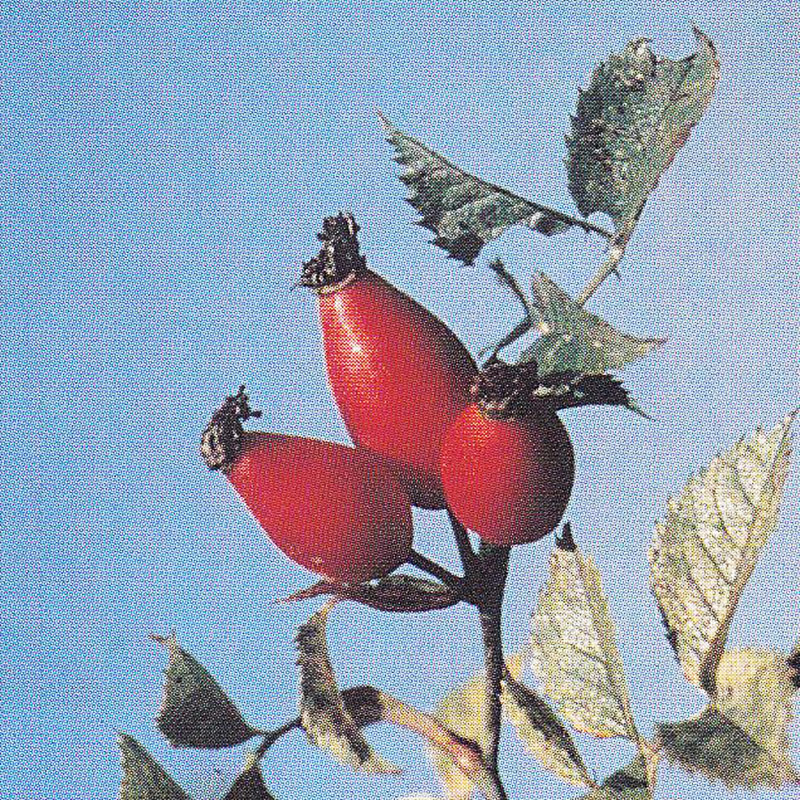
Photo: Herbert E. Maas
The genus Rosa is widespread worldwide and very rich in species. According to “Zander,” there are 152 verified species names and 383 unverified species names, indicating a potential total of up to 535 species worldwide. Four species are listed in pharmacopoeias: dog rose, Alpine rose, Gallic rose, and hundred-petaled rose.
All roses have very decorative, large, colorful flowers, prickles on their branches (not “thorns”!), and bear fruit in a very unusual shape, the “rose hip.” Within the petals, the stamens sit on the inner wall of a jug-shaped, finely hairy hypanthium, inside which the ovaries with their styles are found. After fertilization, the hypanthium arches around the small fruitlets (the rose hip seeds = individual nutlets) and closes at the top, with the hairy styles emerging. These are surrounded by a disc ring. Above this, a stigma head then forms. Once fully ripe (red, orange, or yellow), this structure is then called the “rose hip.” Botanically, it is an aggregate fruit, but a “false fruit” (pseudofructus), as the cup-shaped hypanthium is also involved in fruit formation. With their (mostly red) color, rose hips are a beautiful addition to roses in autumn.
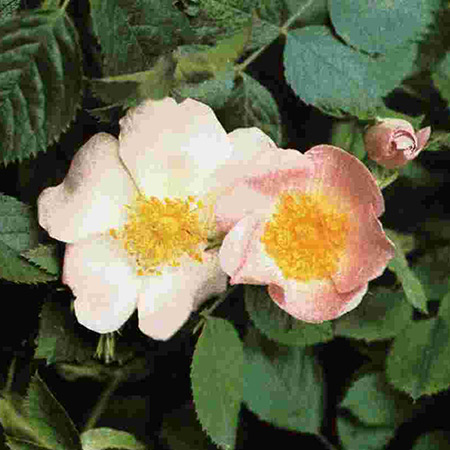
The dog rose - Rosa canina L. (Latin, ‘caninus’ = dog) is a shrub that is widespread throughout Europe and grows on the edges of forests and paths, as a ‘hedge rose’ in field hedges, on limestone meadows and wasteland. It has sprawling, arching branches; its prickles are sickle-shaped or hooked. The flowers are formed by five light pink, cordate petals. The Alpine rose - Rosa pendulina L. grows in deciduous and coniferous forests in the Alps, the Alpine foothills, and the Vosges. It has straight prickles, sometimes absent; the five petals are dark red, and the rose hips are bottle-shaped.
The flowers of the Gallic rose - Rosa gallica L. (Latin ‘gallicus’ = Gallic) are broad, inverted cordate, pink to red, and usually broadly notched at the front. Its rose hips are spherical, brownish-red, and covered with glands and prickles. The flowers were formerly used to make rose vinegar, which was commonly used in medicine. The hundred-petaled rose - Rosa x centifolia L. (Latin ‘centum’ = hundred, ‘folium’ = leaf) is characterized by its large number of red petals, which make it appear ‘double’. It is a complex hybrid of four wild species (R. gallica, R. moschata, R. phoenicia, R. canina) and is the progenitor of European hybrid tea roses.
Medicinally used parts of plants (herbal drug)
The following are used:
- The dried, whole or crushed accessory fruits (rose hips - Rosae pseudo-fructus cum fructibus) consisting of the hypanthium and fruits, as well as the hypanthium freed from the fruits (achenes) and bearing remnants of the dried sepals (rose hip peels - Rosae pseudo-fructus); source plants: dog rose, Alpine rose.
- The dried, whole or cut petals (rose petals - Rosae flos) collected before full bloom. Source plants: Gallic rose, hundred-petaled rose, and Damask rose.
Constituents of the herbal drug
Rose hip peels contain ascorbic acid, pectins, sugar, fruit acids, and tannins. They also contain carotenoids as colorants. Rose hips also contain the fatty oil from rose hip seeds, which consists mainly of linoleic acid and γ-linolenic acid. Rose petals contain fragrances, tannins, flavonoids, ascorbic acid (vitamin C), and carotenoids.
“Rose oil” is an essential oil used in aromatherapy that is obtained by steam distillation from fresh petals of the Damask rose (Rosa × damascena Mill. = Damask rose oil) in Anatolia and Iran, or from fresh petals of the R. gallica L. in Georgia and Azerbaijan (Gallic rose oil). Rose oil contains 50 to 80% monoterpenes, mainly geraniol, nerol, linalool, and citronellol.
Quality of the drug
The quality of rose hip peels (Rosae pseudo-fructus) is specified in the European Pharmacopoeia (Ph. Eur.), while the quality of rose hips (Rosae pseudo-fructus cum fructibus) is specified in the German Drug Codex (DAC). According to the pharmacopoeia, rose hip peel may also be obtained from other species of the genus Rosa.
The quality of rose petals (Rosae flos) is specified in the European Pharmacopoeia (Ph. Eur.).
Medical applications
Recognised medical use
Rose hip peels and rose hips
The HMPC has not evaluated rose hip peels and rose hips.
ESCOP: Rose hips and rose hip peels: Supportive in the treatment of colds and flu. Indications are based on findings from long-standing use in humans. Rose hips: Supportive in the relief of pain and stiffness associated with osteoarthritis.
Traditional use
Rose petals have been classified by the HMPC as a traditional herbal medicinal product (Article 16a of Directive 2001/83/EC). Based upon long-standing use, rose petals can be used externally for mild inflammation of the skin or lining of the mouth and throat.
Herbal drug preparations in finished dosage forms
Rose hip peels
- Cut rose hip peels loose or in tea bags, for tea preparation or as an “other ingredient” in tea blends (cold teas)
- Powdered rose hip peels and rose hip fruits (dietary supplements)
Cut rose petals for tea infusion preparation
Dosage
Finished medicinal products: Not applicable.
Tea: Rose hips: Drink 1 cup of rose hip tea several times a day.
Rose petals: Use 3 times a day as a mouthwash. For skin treatment, apply moist compresses 3 times a day.
Preparation of a tea
Rose hips: Pour boiling water over 2 to 2.5 g of crushed rose hips (peels) and strain after 15 minutes.
Rose petals: Pour 150 mL of boiling water over 2 g of chopped rose petals, strain after 10 minutes, and allow to cool.
Notes
Rose hips and rose hip peels are not classified as medicinal products, but as foodstuffs. They are an ingredient in fruit teas. In medicinal teas (e.g., cold teas), they are classified as “other ingredients” because they are mainly added to improve the taste.
Side effects
None known.
Interactions
None known.
References
Herbal drug monographs
HMPC (2014, 2024), ESCOP (2009)
Further literature
Commentary on the European Pharmacopoeia (rose hip peel, No. 1510)