

Yarrow
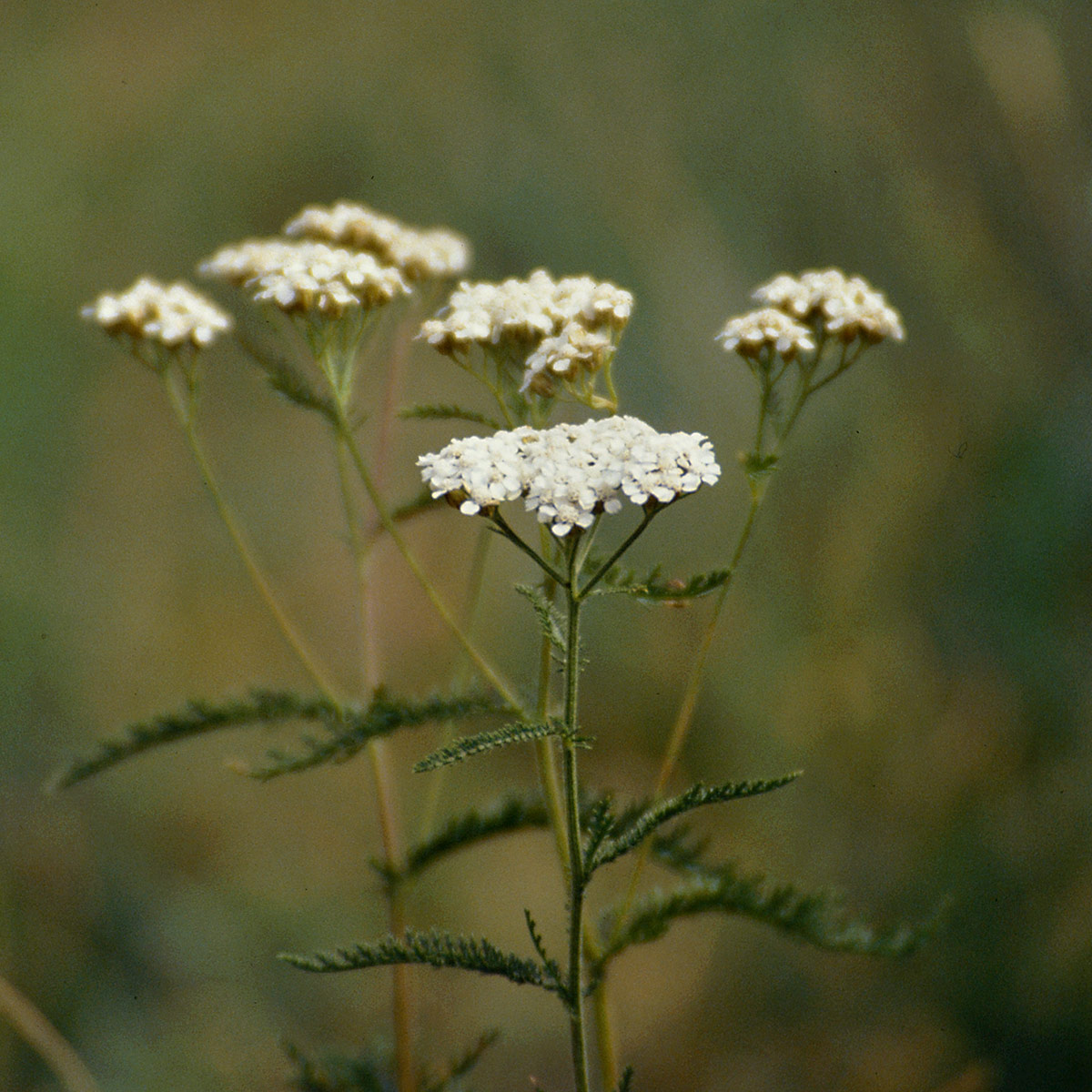
Botanical name
Achillea millefolium L. s.l.
Family
Asteraceae
Common name
Common yarrow, Milfoil, Soldier's woundwort, Nosebleed plant, Devil's nettle, Old man’s pepper
Information about the plant
The addition of "s.l." (sensu latiore = in the broader sense) to the botanical name indicates that it refers to a diverse group of species. The Achillea millefolium group includes many smaller species that colonize different areas throughout Europe due to their different soil and climate requirements. The plant can be found in meadows, pastures, dry fields, and along roadsides.
Achillea is known as the "herb of Achilles." Achilles came to Troy in search of Mysia and injured the king of the Mysians, Thelephos, on the thigh. He healed the wound with a medicinal plant, which was later identified as yarrow. The epithet millefolium refers to the characteristic shape of the leaves. They are repeatedly pinnatisect with numerous, very narrow leaflets, which give the impression of "a thousand leaves" (Latin mille = thousand, folium = leaf).
Many flower heads are arranged in corymbs at the top of heavily branched stems. They are 5 to 8mm in diameter and have relatively small 4 to 6 white to pinkish-red ray florets and only a few pale-yellow tubular florets. This plant, which grows to a height of 30 to 60 cm, is a preferred forage plant for sheep.
Medicinally used parts of plants (herbal drug)
The dried flowering shoot tips, including leaves, flowers, and stems (yarrow herb – Millefolii herba), as well as the flowers (yarrow flowers – Millefolii flos), are used.
The commercially available drug comes from southeastern and eastern European countries, as well as from Germany.
Constituents of the herbal drug
Yarrow contains a volatile oil, sesquiterpene lactones (especially guaianolides), flavonoids, and caffeoylquinic acids.
Quality of the drug
The quality of yarrow herb (Millefolii herba) is specified in the European Pharmacopoeia (Ph. Eur). There is no pharmacopoeial quality specification available for yarrow flowers (Millefolii flos).
Medical applications
Recognised medical use
The HMPC has classified yarrow herb and yarrow flowers as traditional herbal medicinal products (see “Traditional Use”).
ESCOP: Yarrow herb for internal use in loss of appetite and dyspeptic complaints such as mild cramping in the lower intestine, as well as for menstrual cramps; for external use to treat minor wounds and mild inflammations of the skin and mucous membranes, as well as insect repellent. In the form of hip bath for painful cramping in the female pelvis. These indications are based on findings from human experience and long-standing use.
Traditional use
Yarrow herb and yarrow flowers have been classified by the HMPC as traditional herbal medicinal products (Article 16a of Directive 2001/83/EC). Based on long-standing use, yarrow herb and yarrow flowers can be used internally for temporary loss of appetite, to treat mild cramping in the gastrointestinal tract accompanied by bloating and flatulence, and for mild menstrual cramps. Externally, yarrow herb and yarrow flowers can be used to treat small, superficial wounds.
Herbal drug preparations in finished dosage forms
- Chopped yarrow herb or yarrow flowers for tea preparation
- Dry extracts in coated tablets
- Tincture in drops
- Achillea millefolium homeopathic mother tincture in drops
Dosage
Finished pharmaceutical products: See patient information leaflet.
Tea: Drink one cup of yarrow herb tea or yarrow flower tea 3 to 4 times daily between meals. Daily dose: 4–6 g of the herb.
Preparation of a tea
Pour approximately 150 mL of boiling water over 2 g of finely chopped yarrow herb or 2 g of yarrow flowers and strain after 10 to 15 minutes. For hip (sitz) baths, prepare an infusion with 100 g of yarrow herb in 1 to 2 L of water, which is added after drawing the bath water and left for 20 minutes.
Notes
Yarrow or yarrow preparations must be avoided in cases of known allergies to other Asteraceae (cross-allergy is possible). There are no studies available on the use of yarrow during pregnancy and lactation, or in children under 12 years of age.
Side effects
Rarely, contact allergies (yarrow dermatitis).
Interactions
None known.
References
Herbal drug monographs
HMPC (2011, 2019, 2020), ESCOP (2021), WHO (Vol. 4, NIS)
Further literature
Commentary on the European Pharmacopoeia (Yarrow, No. 1382).