

Sage
Botanical name
Salvia officinalis L.
Salvia fruticosa Mill. (Syn. Salvia triloba L. f.)
Family
Lamiaceae
Common name
Garden sage, Kitchen sage, Golden sage, Culinary sage, True sage, Greek sage
Information about the plant
Common sage is native to the Balkan Peninsula, originally from Dalmatia, and is now widespread throughout the Mediterranean region as far as Portugal. It is also cultivated in many countries. The three-lobed sage grows primarily in Greece, Crete, and Cyprus.
The genus name Salvia is derived from the Latin ‘salvus’ (= healthy, whole, safe, saved), and thus means “the healing one.” The epithet officinalis suggests that it is an old medicinal plant, because "officina" is the salesroom of a pharmacy, and "officinalis" means commonly used in the pharmacy. The specific epithet triloba is derived from Latin and means “three-lobed.” This refers to the small lobes at the base of the leaves, which are characteristic of this plant and make the leaf appear three-lobed, a much more pronounced feature than in common sage.
Common sage is an aromatic subshrub growing up to 70cm tall, while three-lobed sage can reach up to 1.20 m. Both species become woody very quickly at the base. The leaves are relatively thick, gray-green, with notable white tomentose hairs on the abaxial surface, more pronounced in three-lobed sage. At the base, they often have two small lateral leaflets, called auricles. In three-lobed sage, these are always present and slightly larger.
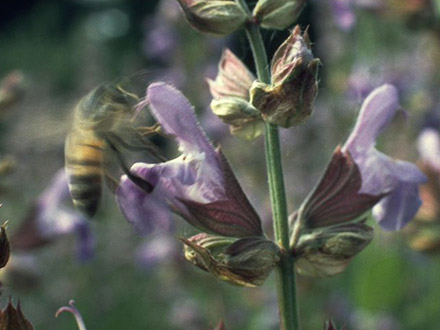
When rubbed, the leaves of both species release a very characteristic and pleasant smell due to the essential oil. This oil is contained in glandular scales on the leaf surface. When these are damaged, the essential oil is released. Numerous blue Lamiaceae flowers are arranged above the foliage in loose spikes of 5 to 10 flowers. The flowering period is from June to July.
Medicinally used parts of plants (herbal drug)
The dried leaves (Salviae folium, Salviae trilobae folium) are used with their characteristic sage scent, which is clearly perceived when rubbed.
The commercially available drug is imported from southeastern European countries.
Constituents of the herbal drug
Common sage leaves contain essential oil with an aromatic scent of thujone, 1,8-cineole, and camphor; the oil of three-lobed sage contains 1,8-cineole as its main component, giving it a scent somewhat reminiscent of eucalyptus oil. Both oils also contain other monoterpenes.
They also contain bitter diterpene phenols and tannins (primarily rosmarinic acid) as well as flavonoids.
Quality of the drug
The quality of the following drugs and drug preparations is specified in the European Pharmacopoeia (Ph. Eur.):
- Sage leaf (Salviae officinalis folium)
- Sage tincture (Salviae tinctura)
- Three-lobed sage (Salviae trilobae folium)
Medical applications
Recognised medical use
Common sage leaves
The HMPC has classified sage leaves as a traditional herbal medicinal product (see “Traditional Use”).
ESCOP: Dyspeptic symptoms such as heartburn and bloating, excessive sweating, hot flashes, supportive treatment for hyperglycemia and hyperlipidemia. External use for inflammation and infections of the oral mucosa, gums, and pharyngeal mucosa.
Three-lobed sage
HMPC: see “Traditional Use”
ESCOP: External use for inflammation and infection of the mouth and throat, such as stomatitis, gingivitis, and pharyngitis. Internal use for dyspeptic symptoms. These indications are based on long-standing use and human experience.
Sage Oil
The HMPC concluded in a public statement on “sage oil” that, when assessing the benefit-risk ratio for internal use, the risks outweigh the benefits. This is due to the presence of toxic thujone, a neurotoxin that causes epileptiform seizures when taken over a prolonged period or in high doses. Therefore, internal use of sage oil is not recommended.
Traditional use
Common sage leaves
The HMPC has classified sage leaves as a traditional herbal medicinal product (Article 16a of Directive 2001/83/EC). Based upon long-standing use, common sage can be used internally for mild dyspeptic symptoms such as heartburn and flatulence, and to reduce excessive sweating. Externally, it can be used for the symptomatic treatment of inflammation in the mouth and throat, and for mild skin inflammation.
Three-lobed sage
The HMPC discontinued the monograph development due to inconsistent findings regarding its efficacy across countries. Consequently, sufficient long-term experience for traditional use is not available.
Herbal drug preparations in finished dosage forms
- Chopped common sage leaves or chopped three-lobed sage for tea preparation
- Alcoholic (tincture) and aqueous extracts in drops, gargles, and ointments
- Fluid extract in liquid preparations
- Dry extracts in tablets
- Steam distillates mixed with other herbs in drops
- Sage oil in liquid preparations (for external use only)
Dosage
Finished medicinal products: See patient information leaflet.
Herbal tea: Daily dose 4 to 6 g of sage leaves.
Sage tincture: Daily dose 2.5 to 7.5 g.
Fluid extract: Daily dose 1.5 to 3 g.
Sage oil for external use: Daily dose 0.1 to 0.3 g.
For gargling and mouthwashes, use 2.5 g of the herb or 2–3 drops of essential oil in 100 ml of water as an infused solution, or 5 g of an alcoholic extract in a glass of water, several times daily. For topical application, apply alcoholic extracts (tincture) undiluted several times daily.
Preparation of a tea
Pour 150 mL of boiling water over 3 g of finely chopped common sage leaves or three-lobed sage leaves, steep for 10 minutes, then strain. Use warm as a gargle solution or drink cooled to relieve night sweats. For gastrointestinal symptoms, pour 150 mL of boiling water over 2 g of the herb and strain after 5 minutes.
Notes
The toxic dose of thujone is not reached when sage leaf preparations (tea, tincture) are taken internally. A maximum intake of 6.0 mg of thujone per day is considered safe. For internal use, it is recommended to use low-thujone varieties whenever possible. No studies on safety are available for the use of sage during pregnancy and lactation. Use in children and adolescents under 18 years of age is not recommended due to a lack of evidence.
Side effects
None known.
Interactions
None known.
References
Herbal drug monographs
HMPC (2016, 2017), ESCOP (2014, 2021), WHO (NIS)
Further literature
Commentary on the European Pharmacopoeia (Common sage leaves, No. 1370; Sage Tincture, No. 1889; Three-lobed sage, No. 1561)